Thank you, dear reader, for sticking with me for Hardcoded, a series on the emergency camp on functionality of mobile phones used in Australia, that is, their ability to dial emergency service numbers like 000 when their home telecom network is unavailable (I abbreviate that to ‘camp on’).
Having gone through the context, technicalities, fallout and regulatory landscape for this telecommunications policy fiasco, we are in the ‘Where to from here?’ phase.
And in that phase, we’ve looked at the need for: all phones to be network-agnostic with respect to dialling emergency services; robust device testing regimes; the importance of robust situational awareness by all stakeholders; as well as the failures of the state.
We kicked off our discussion about the failures of the state in Absentee where we focused on the substandard regulatory methods of the Australian Communications and Media Authority (‘ACMA’).
In the present article, we will hone in on a particularly egregious and ongoing regulatory failure from the ACMA and larger Australian Government allowing the telcos to block phones willy nilly from their networks.
Before that, some housekeeping to refresh our memories about key concepts and terms.
Housekeeping
Some keywords about dialling emergency services over here:
The general emergency service number is 000 (the one I focus on in Hardcoded), while 106 is the one for use with teletypewriters and 112 is an alternative number for mobile phone users, as per Telecommunications Act 1997 (Cth) s 466(2) (‘Telecommunications Act’) and Telecommunications Numbering Plan 2025 (Cth) s 20.
An ‘emergency call service’ (‘ECS’) handles calls to emergency service numbers and ensures that emergency services are dispatched when and where they are required (to summarise the definition in Telecommunications Act s 7). Our federal telecommunications regulator, the ACMA, oversees ECSes in Australia as per part 8 of the Telecommunications (Consumer Protection and Service Standards) Act 1999 (Cth).
Also note the following key acronyms:
LTE = Long Term Evolution = A 4G telecommunications standard enabling wireless broadband communication for mobile devices at faster speeds than on 2G/3G networks.
eVoLTE = A configuration which allows your phone to make an emergency voice call on an LTE network. I’m borrowing from TPG Telecom’s use of ‘eVoLTE’ in this fashion, rather than the industry shorthand for ‘Enhanced/Evolved VoLTE’.
000 Inquiry = The Senate Environment and Communications References Committee’s inquiry into the September 2025 000 outage.
TPG = TPG Telecom, the company which used to be called ‘Vodafone Hutchison Australia’ but became part of the TPG telecommunications group by merger in 2020 and is listed on the ASX.
Off to the Races
The obligations of telcos that I’m focusing on in this piece are enshrined in the Telecommunications (Emergency Call Service) Determination 2019 (Cth) pt 4 (‘ECS Determination’). Part 4 commenced on 28 October 2024 and requires telcos (‘carriage service providers’—I clarified the difference between them and ‘carriers’ here) to:
identify any mobile phones connected to their networks that aren’t/are no longer configured to access the ECS—which I assume to mean the one for 000 and 112—whether via the providers’ own networks or those of other providers: sections 64(2), 66(2), 68;
notify the end-users of those phones that their devices aren’t/are no longer configured to access the ECS (notification obligations vary by whether the end-users are customers and if the devices can no longer access the ECS): sections 65(2)(a), 67(2)(a), 69(2)-(3);
block those phones from their networks (blocking timeframes vary by whether the end-users are customers): sections 65(2)(b), 67(2)(b), 69(4); and
inform the end-users of those phones about alternative devices, including low/no cost ones that can access the ECS: sections 65(2)(c), 67(2)(c), 69(5). The providers must also ensure they provide for ≥ one way for customers doing it tough to get help in obtaining low/no cost phones that can access the ECS: section 70.
Note that the notification, blocking and alternative device information obligations don’t apply in relation to a phone, as per section 71:
which is used by a ‘foreign traveller’ intending to stay in Australia ≤ 90 consecutive days; and
to which the carriage service provider ‘has sent a notification … to the effect that the mobile phone is not configured’ to access the ECS.
With that important bit of law out of the way, now for the reality.
Australian telecommunications expert, James Parker, quite laconically describes the minimal at best oversight of telcos’ compliance with their blocking obligations by declaring that ‘The telcos get to be judge, jury and execution[er]’.
As Parker has documented in multiple pieces, there is a real risk of telcos blocking ECS-capable devices from their networks, with that risk having indeed become manifest in scores of devices (including those on the telcos’ own allowlists) being kicked off their networks since the blocking obligations went into effect.
Swinging at a Piñata while Blindfolded
As I summarised in Cognisance, part of the problem is that the telcos aren’t using a scalpel. They’re using a sledgehammer. One made of vibranium at that.
When it comes to the problematic Samsung models, they have asked Samsung for the Type Allocation Code (‘TAC’) of the relevant phone and the software version which the phone must be on if it is patched for camp on (see, eg, the testimony of Samsung Electronics Australia’s Head of Mobile Division, Eric Chou, at the 000 Inquiry).
Thing is, the TAC merely comprises the first eight digits of the device’s International Mobile Equipment Identifier (‘IMEI’) number. It is, essentially, a model label. It doesn’t say anything about the ability of that device to access the ECS for 000 and 112. Same goes for the IMEI-SV (IMEI Software Version) number.
As Parker put it (emphasis added):
The equivalent analogy [to using a hardware identifier for a handset in this way] would be like determining the roadworthiness of a car based on the make & model and where it was sold rather than if an individual vehicle is actually roadworthy or not.
The IMEI-SV (and SVN) does not correlate with the modem/carrier profile (or CSC) installed or running on the device at a given time, nor the exact capabilities for Emergency Calling.
With the vehicle/VIN example, because there is no ‘one source of truth’, essentially what largely occurred (and is occurring) is anything not sold by the ‘main dealer’ (telcos) or ‘dealer’ (telco) partners (handset vendors) was deemed ‘not roadworthy’ and banned from use, whilst anything from the ‘dealers’, or major ‘dealer partners’ was allowed to be used.
The telcos are flying blind by referring to stuff like the TAC/IMEI-SV when trying to divine the (e)VoLTE capabilities of handsets and deciding to block phones partly on the basis of who sold them.
It is thus little wonder that a May 2025 analysis by the ABC found Telstra and Optus to be ‘inconsistently blocking 16,822 registered device types — based on their TAC codes’, with Optus blocking 15,844 device types that Telstra hadn’t blocked. It gets even weirder as Optus’s website listed, in September 2024, some Samsung models as safe despite their firmware build dates going back several years. Evidence-based compatibility checks, yeah?
In the absence of robust and standardised problem device identification procedures (as implied in Chou’s testimony to the 000 Inquiry), the telcos arguably still are swinging at a piñata while blindfolded.
Even Foreign Travellers Aren’t Spared
The above gets worse when we look at the implementation of the exemption under the ECS Determination s 71 regarding foreign travellers intending to stay here ≤ 90 days (as flagged above).
Telstra and Optus reportedly blocked tons of foreigners’ phones on 28 October 2024, the very day the blocking obligations commenced.
Since you may wonder why, Telstra itself warned in its October 2024 submission to the ACMA’s consultation that this exemption is, well, unworkable (emphasis added):
… it is not possible to unambiguously identify international travellers arriving in Australia with a mobile phone that we know is unable to make emergency calls from Australian residents … [I]t is not possible to accurately determine whether the person purchasing a prepaid SIM is a foreign traveller or a local resident.
[T]he blocking mechanism is completely unaware of the cohort the end user may belong to.
Which was a few months after it told the Senate Rural and Regional Affairs and Transport References Committee that:
For the period between 1-28 July 2024, there was a total of just over 2.3 million international roaming devices connected to Telstra’s network. Telstra is not able to provide a definitive number of 3G-only international roaming devices, due to how international roaming operates.
Secondly, 4G voice calls are managed by the home network with no record within the roaming network, e.g. Telstra. Therefore, we cannot confirm the 4G voice calling capability of these devices.
Have to say, when I first read the text of the exemption, I myself was wondering how on earth a telco would ascertain if someone’s a non-resident and how long they intend to stay here. Which is on top of their having to clock millions of foreign travellers over here with phones on roaming.
Which itself is on top of a telco, as the roaming network operator, being unable to figure out whether those phones are (e)VoLTE capable.
Here’s Telstra’s messaging even today (emphasis added):
If you’re visiting from overseas and your device isn’t compatible with our network, it will be blocked from connecting. This is instantaneous from when you first turn on your phone. Your phone will still work once you leave Australia, and can still be used with Wi-Fi.
To an extent, this makes sense from an operational standpoint. After all, if you’re the compliance team at a telco, with your Board and senior execs concerned about greater politico-regulatory and narrative heat in the wake of multiple 000 outages in recent years, wouldn’t you operate on the basis of ‘When in doubt, block’? Especially when you have such a hard time figuring out if the phone is subject to the exemption in ECS Determination s 71 in the first place?
Such behaviour makes even more sense when the ACMA, backed by the wider Australian Government, merely looks on. Indeed, the regulator regarded device blocking more generally as ‘a matter for the telcos to determine’, given the latter having ‘the best knowledge of their own networks’ (a laughable statement from an operational standpoint, given the extraordinary technology debt populating telecoms infrastructure).
Forced Obsolescence
As foreshadowed above, there is also a real issue with telcos blocking 000-capable phones, at least partly, because they didn’t sell those phones.
Another Australian telecommunications expert and practitioner, Nick Jones, described such TAC-based blocking as a ‘scattergun approach’. This has also been repeatedly flagged by Parker.
Heck, the then-Telecommunications Industry Ombudsman, Cynthia Gebert, testified at the Senate Rural and Regional Affairs and Transport References Committee’s inquiry into the 3G shutdown in July 2024 that her office had dealt with complaints from ‘customers … [who] have been encouraged [by their telco] to purchase additional devices that may not have been a direct replacement’. This was said to include more expensive mobile plans and offers of ‘additional products … [to be] sold as a broader package’.
In this vein, Parker also found that, of 255 models reported to him as blocked as of November 2024, close to three-quarters were running a version of Android released at least in 2021. So much for the narrative about ‘only old relics will be blocked’.
Phone OEMs like Samsung as well as telcos are arguably thus ‘forcing obsolescence’ by selling phones with hardware which is eVoLTE-capable, but not shipping/being able to ship telco-specific firmware patches to enable said hardware to camp onto a given telco’s towers (as I summarised in Technicalities). Which is far from ethical during a cost-of-living crisis, as suggested by the tons of comments from angry Australian phone users under this 2023 video on device blocking.
Oh, and did I mention that phones may still get blocked, despite having the required telco-specific eVoLTE configurations on file, because they aren’t set up to actually run the necessary configuration when the given telco’s SIM card is inserted?
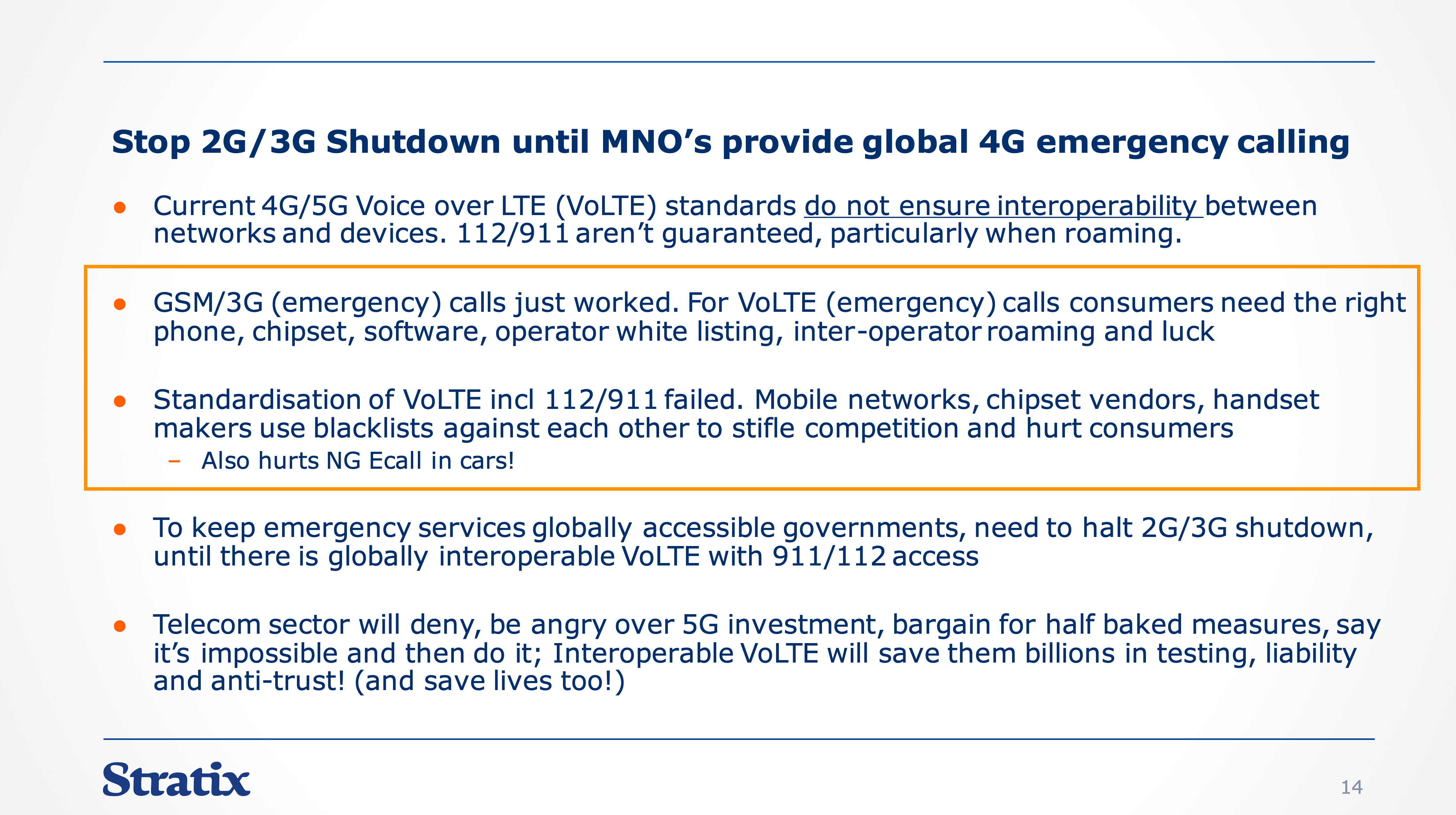
To reiterate my position from Technicalities, the implementation of (e)VoLTE has been an utter dog’s breakfast. As was also summarised in an April 2022 preso by Dutch telecommunications expert, Rudolf van der Berg:
There are very real antitrust issues here, not merely consumer protection/misleading or deceptive conduct issues, something which I foreshadowed in Technicalities and Agnosticism and which Parker also flagged in his submission to the Bean Review (quoted and emphasis added):
Currently providers are able to use this Telco Specific VoLTE firmware requirement as a stealth way of network locking their devices and preventing customers from switching to competitors or from using BYO devices.
But fear not, then-federal Minister for Communications (now-federal Attorney General), Michelle Rowland MP, issued the following firm language in an October 2024 letter:
I have made it clear to the industry that I expect devices affected by the 3G switch off to be reliably identified. Telstra, Optus and TPG Telecom have indicated to me that their methodologies have been independently verified as based on sound and established industry practices.
And how has that worked out, exactly? And who did the independent verification, pray tell?
‘Spectational Regulation’
Fair to say, in practice, the ACMA and the Australian Government have been mute spectators.
They have even allowed telcos to, well, scare consumers into replacing devices willy nilly. Amaysim (owned by Optus) warned customers in May 2024 that ‘IT’LL BE MAYHEM’ once its 3G network was shut down. In November 2025, Optus itself warned customers that they needed to update their phones to at least Android 13—irrelevant advice prompting customers to buy new phones to maintain access to telecommunications—only to retract the warning and issue new advice.
I note that, in October 2024, the ACMA warned in the impact analysis for the then-proposed blocking obligations that (emphasis added):
There may be a conflict of interest in having carriers determine which devices need to be blocked, since they stand to benefit from selling replacement devices.
It also promised to (emphasis added):
work with industry to receive reporting against key metrics at intervals of 2 months, 6 months, and 12 months post-implementation. We anticipate major providers will provide relevant information voluntarily, but the ACMA can rely on formal powers in the Telecommunications Act to require providers to give information and data if necessary.
The ACMA also told the ABC in May 2025 that it ‘has been in constant contact with telcos to monitor [their] compliance [under the ECS Determination pt 4] … and respond to and resolve customer issues as they arise’.
Except that, at that stage at least, the regulator hadn’t even asked the telcos for data against said ‘key metrics’.
In the same ABC News article, the government refused to comment on the ACMA’s absence of enforcement and the regulator’s failure to ask telcos for the aforementioned data.
Go figure.
And stay tuned for the next edition of Hardcoded.